
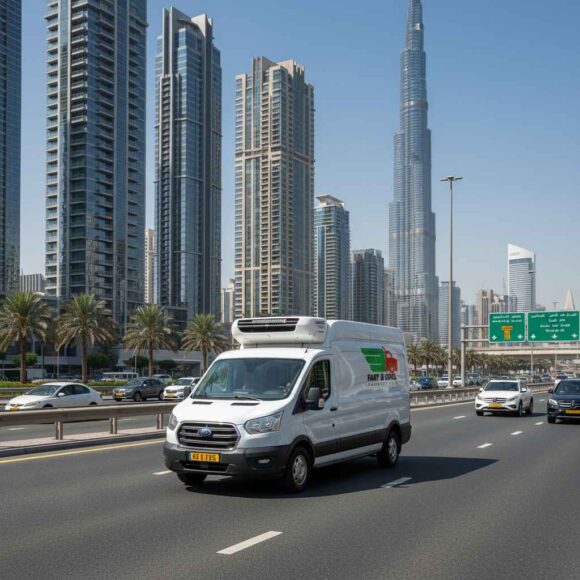
The Invisible Infrastructure That Keeps the UAE Fed, Healthy, and Running
Every morning, hundreds of thousands of UAE residents open a refrigerator that contains fresh milk delivered overnight from a dairy distributor, medication that travelled from a pharmaceutical warehouse to a pharmacy in a temperature-controlled van, and produce that cleared Dubai Airport’s cargo terminal in a refrigerated truck before dawn. None of these people think about the logistics that made their breakfast, their medicine, or their dinner possible. They don’t need to. The cold chain worked.
Cold chain logistics is the term for the end-to-end system of processes, infrastructure, and transport solutions that keeps temperature-sensitive goods within a required thermal range from the point of production or import to the point of consumption or use. It is called a “chain” because it is exactly that a series of interconnected links, each of which must hold for the entire system to function. A single broken link a warehouse cold room that malfunctions overnight, a delivery driver who leaves the van doors open too long during loading, a chilled delivery van whose refrigeration unit is not maintained to the right standard is enough to compromise every link that came before it.
For businesses operating in the UAE one of the most logistically sophisticated and climatically demanding markets in the world understanding cold chain logistics is not optional background knowledge. It is a commercial and regulatory necessity.
Why the UAE Presents Unique Cold Chain Challenges
Cold chain logistics is a global discipline, but the UAE version of it operates under conditions that make it significantly more demanding than the equivalent operations in most other markets.
Temperature extremes are the most obvious factor. The UAE’s summer ambient temperatures regularly exceed 45°C in Dubai and Abu Dhabi, and in industrial areas where much of the country’s warehousing and logistics activity is concentrated, surface temperatures asphalt, metal roofing, vehicle exteriors can exceed 70°C. This means the thermal load on refrigerated transport infrastructure is substantially higher than in European, North American, or East Asian markets where most of the world’s cold chain equipment is designed and tested.
Import dependency is the second major factor. The UAE imports over 80 percent of its food supply, along with the vast majority of its pharmaceutical products and temperature-sensitive consumer goods. This means that cold chain management in the UAE doesn’t begin at a local farm or factory it begins at Dubai Port, Jebel Ali, or Dubai International Airport, where temperature-sensitive cargo must transition from international shipping cold chain conditions into UAE domestic distribution infrastructure seamlessly and immediately.
Speed of commerce adds a third dimension. The UAE operates at a commercial pace that demands cold chain solutions capable of rapid response, flexible deployment, and operational precision under time pressure. A five-star hotel that runs short of fresh seafood at lunchtime, a hospital pharmacy that needs an urgent vaccine delivery, a pop-up event that requires cold catering logistics assembled in 12 hours these are not edge cases in the UAE. They are Tuesday.
The Five Links of the Cold Chain
Understanding cold chain logistics means understanding the distinct stages through which temperature-sensitive goods pass from origin to end use. Each stage has its own infrastructure requirements, risk profile, and quality standards:
Production and origin cold management
Is the first link. Whether it is a dairy farm chilling raw milk immediately after collection, a pharmaceutical manufacturer storing finished products in validated cold rooms at 5°C, or a fishing vessel icing fresh catch from the moment of landing, the cold chain begins at the point of production. For UAE importers, this stage typically happens outside the country in the farms of Holland, the fish processing facilities of Norway, or the vaccine manufacturing plants of Belgium but the cold chain continuity from these origins to UAE soil is the importer’s responsibility to verify.
Cold storage and warehousing
Is the second link the fixed infrastructure where temperature-sensitive goods are held between production and distribution. The UAE has invested substantially in world-class cold storage facilities, particularly in Jebel Ali, Dubai Industrial City, and Abu Dhabi’s ICAD industrial zones. Maintaining the cold chain through this link requires validated cold room equipment, continuous temperature monitoring, and operational protocols that prevent temperature excursions during stock movements within the facility.
Cold chain transport
Including the chilled delivery van, the refrigerated truck, and the chilled delivery truck is the third and most dynamic link. It is where the cold chain leaves the controlled environment of a warehouse and enters the unpredictable reality of roads, traffic, weather, and human operation. This is where the UAE’s ambient temperature challenge is most acute, and where the quality of the transport vehicle and the competence of the driver matter most.
Last mile and final delivery
Is the fourth link the segment from a distribution hub or retail receiving point to the end customer or consumption point. This is the most fragmented, most frequently repeated, and often the most poorly managed link in the chain. For consumer-facing businesses online groceries, pharmacy delivery services, food delivery platforms the last mile is also the most brand-critical link, because it is the one the customer directly experiences.
End-point cold chain management
Is the fifth link what happens after delivery. A restaurant receiving fresh produce that immediately stores it correctly in a walk-in chiller. A clinic receiving vaccines that logs the delivery temperature and transfers product into a validated vaccine fridge. A supermarket receiving frozen goods that moves them into the frozen aisle without delay. The cold chain’s final link is the receiving party’s responsibility, but a professional cold logistics provider like Fast and Cool Transport ensures that every handover is documented and that receiving parties are equipped to complete the chain correctly.
Chilled Transport Services The Core of Cold Chain Movement
Within the cold chain, chilled transport services form the operational backbone of daily temperature-sensitive goods movement across the UAE. This category encompasses everything from a small chilled delivery van making last-mile grocery runs in Dubai’s residential neighbourhoods to a fleet of large chilled delivery trucks replenishing supermarket cold aisles across all seven emirates every morning.
The technical requirements for chilled transport differ significantly depending on the product category being moved. Fresh produce, dairy, and fresh meat require consistent temperatures between 0°C and 8°C. Pharmaceutical products typically require the tighter band of 2°C to 8°C with continuous temperature logging and documentation. Controlled room temperature medicines require management between 15°C and 25°C a range that a UAE summer ambient environment makes impossible to achieve without active temperature control. Frozen products require -18°C or below at all times.
A professional chilled transport services provider must be equipped to serve all of these categories with the right vehicles, the right monitoring systems, and the right operational protocols for each one. A chilled delivery van suited to fresh produce deliveries is not automatically suited to pharmaceutical cold chain work. Matching the right vehicle and service standard to the right cargo category is one of the most important skills a cold logistics partner brings to a client relationship.
Cold Chain Compliance in the UAE What the Regulations Actually Require
Cold chain logistics in the UAE operates within a regulatory framework that is among the most comprehensive in the region. Understanding the key authorities and their requirements is essential for any UAE business involved in temperature-sensitive goods:
- Dubai Municipality sets and enforces food safety standards for food transport and storage in Dubai, including requirements for vehicle hygiene, temperature management, and driver food handling training.
- Abu Dhabi Agriculture and Food Safety Authority (ADAFSA) performs the equivalent function in Abu Dhabi, with its own distinct inspection and compliance framework.
- Ministry of Health and Prevention (MoHAP) governs pharmaceutical cold chain standards at the federal level, with additional oversight from the Dubai Health Authority (DHA) and the Department of Health (DoH) in Abu Dhabi.
- Emirates Authority for Standardisation and Metrology (ESMA) sets technical standards for food products and cold chain equipment across the UAE.
- For businesses operating cold chain transport in the UAE, compliance with the applicable authority’s requirements is non-negotiable and the consequences of non-compliance extend beyond fines to licence suspension and product seizure.
Common Cold Chain Failures and How to Prevent Them
Even well-run cold chain operations experience failures. Understanding the most common failure points helps businesses build more resilient systems:
Vehicle refrigeration unit failure
Is the most acute cold chain failure mode sudden, total, and potentially affecting an entire vehicle load. The mitigation is rigorous preventive maintenance scheduling and maintaining backup vehicle availability for critical deliveries.
Temperature excursions during loading and unloading
Are among the most frequent and underappreciated cold chain failures. Every minute a refrigerated vehicle’s doors are open in a 44°C environment is a minute of thermal stress on the cargo. Pre-cooling cargo areas before loading, minimising door-open periods, and using insulated staging equipment for transfers all reduce this risk.
Documentation gaps
Particularly in pharmaceutical cold chain create compliance vulnerabilities even when the physical temperature was maintained correctly. Continuous digital temperature logging with timestamped records is the only reliable solution.
Driver behaviour and training gaps
Remain a persistent weak point in many cold chain operations. A driver who doesn’t understand why minimising door-open time matters, or who doesn’t know the correct response to a temperature alarm, is a cold chain risk regardless of the quality of the vehicle they’re operating.
Conclusion
Cold chain logistics is simultaneously one of the most technically demanding and most commercially critical disciplines in modern business and in the UAE, it operates under conditions that amplify both the challenge and the stakes. For every business that touches temperature-sensitive goods whether as a food importer, a pharmaceutical distributor, a catering company, a supermarket, or an e-commerce grocery platform the quality of cold chain transport infrastructure they build or partner with is a direct determinant of their product quality, their regulatory compliance, and ultimately their commercial success.
The chilled delivery van that keeps dairy fresh, the chilled delivery truck that restocks supermarket cold aisles each morning, the chilled transport services that maintain an unbroken pharmaceutical cold chain from airport cargo terminal to hospital pharmacy these are not support functions to the UAE economy. They are the connective tissue that holds the entire temperature-sensitive supply chain together.
Understanding how that chain works, where it is vulnerable, and how to manage it well is the first and most important step toward building a cold logistics operation worthy of the UAE’s standards.
Visit us at: www.fastandcooltransport.com