
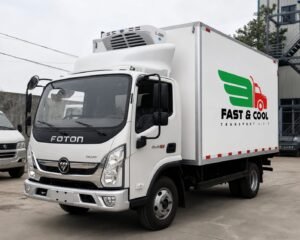
Keeping Cool at Speed: Can a Reefer Hold Temperature in Stop-Start Traffic?
It’s a fair worry. You’ve entrusted a chilled or frozen load to a refrigerated vehicle, and now it’s crawling through Dubai rush hour, stopping and starting, engine idling in 43°C heat. Is your cargo quietly warming up while it sits in traffic? It’s one of the most common questions quality-conscious shippers ask — and the honest answer is reassuring, with one important caveat.
This article explains how reefer refrigeration actually works, why stop-start traffic is far less of a threat than it feels, and where the real risk to your cold cargo lies. Spoiler: it isn’t the traffic jam.
| In short Yes — a properly specified reefer holds temperature well in stop-start traffic. Its refrigeration keeps running whether the vehicle is moving or idling, and its insulated body resists heat gain even in extreme Dubai heat. The real threat to temperature isn’t sitting in traffic with the doors shut; it’s door openings at delivery stops. Manage those, and your cargo stays in range through the worst congestion. |
How a reefer keeps cold — moving or not
A refrigerated vehicle doesn’t cool because it’s driving. Its refrigeration unit — typically a Carrier or Thermo King system — runs continuously to hold the set temperature, and it works the same whether the vehicle is doing 100 km/h on Sheikh Zayed Road or sitting still at a red light. Many units draw power from the engine while others can run on standby, but the principle is the same: the cooling doesn’t switch off just because the wheels stop turning.
So the mental image of cargo warming because the van is stuck in traffic is largely a myth. As long as the unit is running and the doors are shut, an idling reefer holds temperature much like a parked fridge holds temperature — it keeps working regardless of whether it’s going anywhere.
The insulated body does the quiet work
The second line of defence is the box itself. A purpose-built refrigerated body is heavily insulated, engineered to keep heat out and cold in. That insulation is why a well-maintained reefer can hold its temperature for a meaningful time even under load — it slows heat gain dramatically, giving the refrigeration unit an easy job to maintain rather than a constant fight.
This is also where the difference between a proper reefer and a converted van shows. A factory-built, well-insulated body shrugs off ambient heat that would quickly overwhelm a poorly insulated box. In Dubai’s climate, that insulation isn’t a nice-to-have — it’s the thing standing between your cargo and 45°C outside.
The real enemy: door openings, not idling
Here’s the caveat that matters. The genuine threat to temperature isn’t the traffic jam — it’s every time the doors open. At a delivery stop, warm outside air floods in, the cold air spills out, and the unit has to work to recover. A door held open while someone searches for the right pallet does more damage in two minutes than an hour of idling in traffic.
| Event | Effect on temperature | Real risk level |
| Idling in traffic (doors shut) | Unit keeps running; insulation holds | Low |
| Long drive in summer heat (doors shut) | Minor gain; well within unit’s capacity | Low |
| Door opening at a stop | Warm air in, cold air out; recovery needed | High — the main risk |
| Repeated multi-stop openings | Cumulative heat gain across the route | High if not sequenced |
This flips the usual worry on its head. The part of the journey that feels most alarming — sitting in traffic — is the safest. The routine part — opening the doors to deliver — is where temperature is actually won or lost.
How good operators hold the line
Knowing where the real risk sits, a professional cold chain operator manages the door, not the drive:
- Pre-cool the vehicle and the load, so the journey starts with margin in hand.
- Sequence multi-stop routes so the most sensitive cargo is exposed least.
- Group each stop’s items near the doors, so nothing is dug out with the doors open.
- Keep every door opening as brief as possible — the single biggest control.
- Maintain the refrigeration unit and door seals so the box performs as designed.
- Log temperature continuously, so any real drift is caught immediately.
Notice that traffic management isn’t even on the list — because a running unit in an insulated box handles the traffic. The discipline is all at the stops. Thoughtful route planning is the natural partner to this, sequencing the whole run so temperature is protected end to end.
What the temperature log proves
You don’t have to take any of this on faith. A reefer with continuous temperature logging produces a record of the whole journey — and on a well-run trip through heavy traffic, that record shows a steady line, with only small, brief blips at delivery stops as doors open and the unit recovers. That’s the evidence that the cargo stayed in range regardless of the congestion outside.
So the next time your chilled load is crawling through rush hour, you can relax about the traffic and trust the log. A properly specified chiller van, running and sealed, is doing exactly what it’s built to do — holding your cargo cold, moving or not.
Frequently Asked Questions
Does a reefer stay cold while stuck in traffic?
Yes. The refrigeration unit runs continuously whether the vehicle is moving or idling, and the insulated body resists heat gain, so a reefer holds temperature in traffic much like a parked fridge does. As long as the unit is running and the doors are shut, sitting in congestion barely affects the cargo.
If idling is fine, what actually warms the cargo?
Door openings. Every delivery stop lets warm air in and cold air out, forcing the unit to recover — and a door held open too long does far more damage than an hour of idling. That’s why professional operators focus on keeping stops short, not on the drive itself.
Can a refrigerated van cope with Dubai summer heat?
A purpose-built, well-insulated reefer with a maintained Carrier or Thermo King unit is designed for exactly this climate. The heavy insulation slows heat gain and the unit maintains the set temperature, so even 45°C outside stays outside — provided the doors are managed and the vehicle is properly specified.
Is a converted van as good as a proper reefer in traffic?
Usually not. A factory-built refrigerated body has far better insulation than a converted van, so it holds temperature through heat and stops that would overwhelm a poorly insulated box. In Dubai’s climate, that insulation quality is one of the biggest differences between arriving in range and out of it.
How can I be sure my cargo stayed cold on a slow route?
Ask for the temperature log. Continuous logging records the whole journey, and on a well-run trip through traffic it shows a steady line with only small, brief blips at delivery stops. That record is your proof the cold chain held, regardless of the congestion.